OpenNovelty: An LLM-powered Agentic System for Verifiable Scholarly Novelty Assessment
Published in arXiv preprint, 2026
OpenNovelty focuses on a difficult but essential part of research evaluation: verifiable novelty assessment with explicit evidence traces.
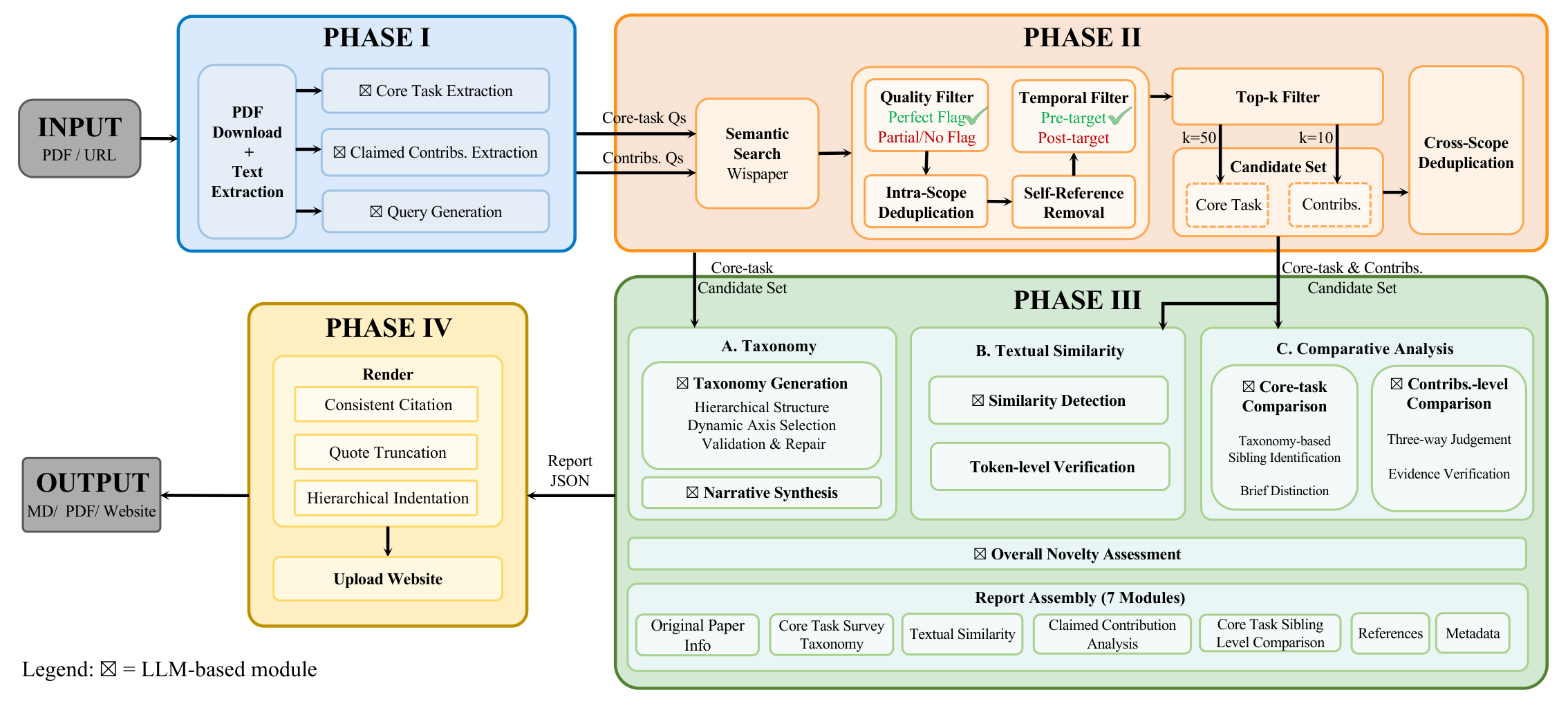
Why this system matters
Novelty review is usually time-constrained, inconsistent across reviewers, and highly dependent on retrieval coverage. OpenNovelty reframes this as a reproducible pipeline problem instead of a one-shot LLM judgment.
Four-phase pipeline
The public repository describes a staged workflow:
- Phase I — Information Extraction
Extract paper text, core task, and contribution claims. - Phase II — Literature Retrieval
Retrieve related work candidates and build citation indices. - Phase III — Deep Analysis
Compare claims with retrieved literature and classify novelty evidence. - Phase IV — Report Generation
Export structured novelty reports (Markdown/PDF) with citations and snippets.
Output artifacts
Typical outputs include:
phase1_extracted.jsoncitation_index.jsonphase3_complete_report.json- final novelty report (
.md/.pdf)
This makes the full process auditable, with intermediate artifacts available for debugging and review.
Quick-start workflow
The repository provides script entrypoints for each phase:
# Phase 1
python scripts/run_phase1_batch.py --papers "<paper-url>" --out-root output/demo --force-year 2026

# Phase 2
bash scripts/run_phase2_concurrent.sh <paper_id> --base-dir output/demo

# Phase 3
bash scripts/run_phase3_all.sh output/demo/<paper_id>

# Phase 4
bash scripts/run_phase4.sh output/demo/<paper_id>
Engineering notes from the repo
- Python 3.8+ environment
- modular scripts for batch and single-paper workflows
- retrieval, analysis, and rendering decoupled by intermediate JSON artifacts
- some external service dependencies are marked as evolving in the current release
Practical takeaway
OpenNovelty is useful when you want traceable novelty review, especially for internal pre-review, large-scale triage, or evidence-grounded reviewer assistance where “why this is novel (or not)” must be inspectable.
Citation
@article{abs-2601-01576,
  author       = {Ming Zhang and
                  Kexin Tan and
                  Yueyuan Huang and
                  Yujiong Shen and
                  Chunchun Ma and
                  Li Ju and
                  Xinran Zhang and
                  Yuhui Wang and
                  Wenqing Jing and
                  Jingyi Deng and
                  Huayu Sha and
                  Binze Hu and
                  Jingqi Tong and
                  Changhao Jiang and
                  Yage Geng and
                  Yuankai Ying and
                  Yue Zhang and
                  Zhangyue Yin and
                  Zhiheng Xi and
                  Shihan Dou and
                  Tao Gui and
                  Qi Zhang and
                  Xuanjing Huang},
  title        = {OpenNovelty: An LLM-powered Agentic System for Verifiable Scholarly
                  Novelty Assessment},
  journal      = {CoRR},
  volume       = {abs/2601.01576},
  year         = {2026},
  url          = {https://doi.org/10.48550/arXiv.2601.01576},
  doi          = {10.48550/ARXIV.2601.01576},
  eprinttype   = {arXiv},
  eprint       = {2601.01576},
  biburl       = {https://dblp.org/rec/journals/corr/abs-2601-01576.bib},
  bibsource    = {dblp computer science bibliography, https://dblp.org}
}